Al-Mawrid companion chapter

Behind
the Walls

If you have arrived here, you have already seen the paintings. This place is for those who want to understand why they exist.

Al-Mawrid was never created by asking, “What should this fortress look like?” It began with another question: how would a civilization survive if water became more valuable than gold?

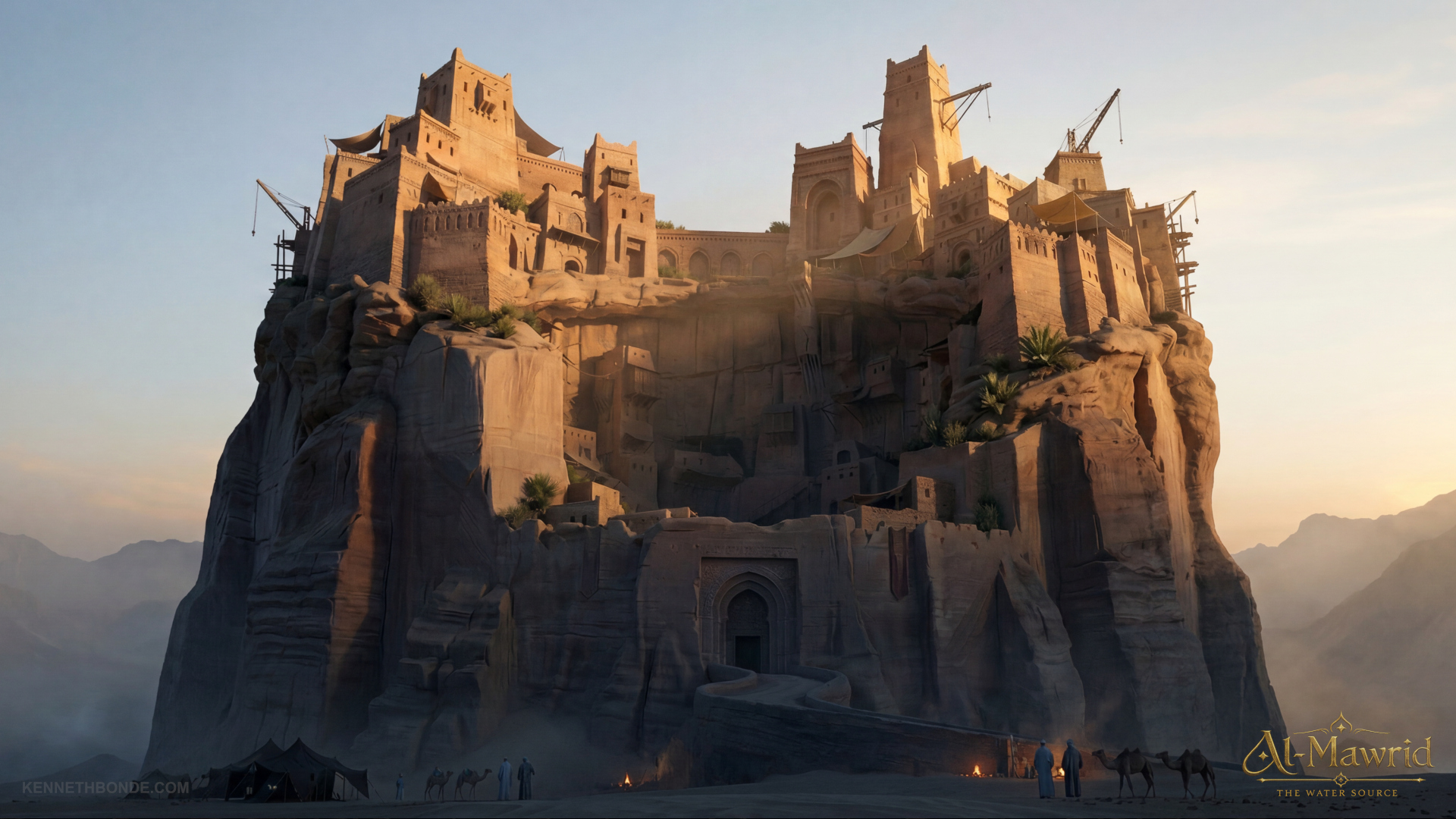
The Al-Mawrid fortress rising from a massive eroded rock formation, with sandstone buildings integrated into the cliff.

Welcome behind the walls

Most visitors stop after looking at the images. This chapter is for the ones who keep looking.

Here the project is not presented as a finished gallery, but as a living world constructed from questions of survival, water, architecture, ritual, and human need. The visible presentation shows selected moments. This companion chapter reveals the thinking that connects them.

The intention is not to explain every mystery. Al-Mawrid works best when the viewer feels there is more beyond the frame: streets continuing into shadow, unseen chambers below the rock, caravans arriving from distant places, and political tensions moving quietly beneath the surface.

Choose a path

Each path opens a different layer of the world. Together they explain how Al-Mawrid became more than a desert fortress.

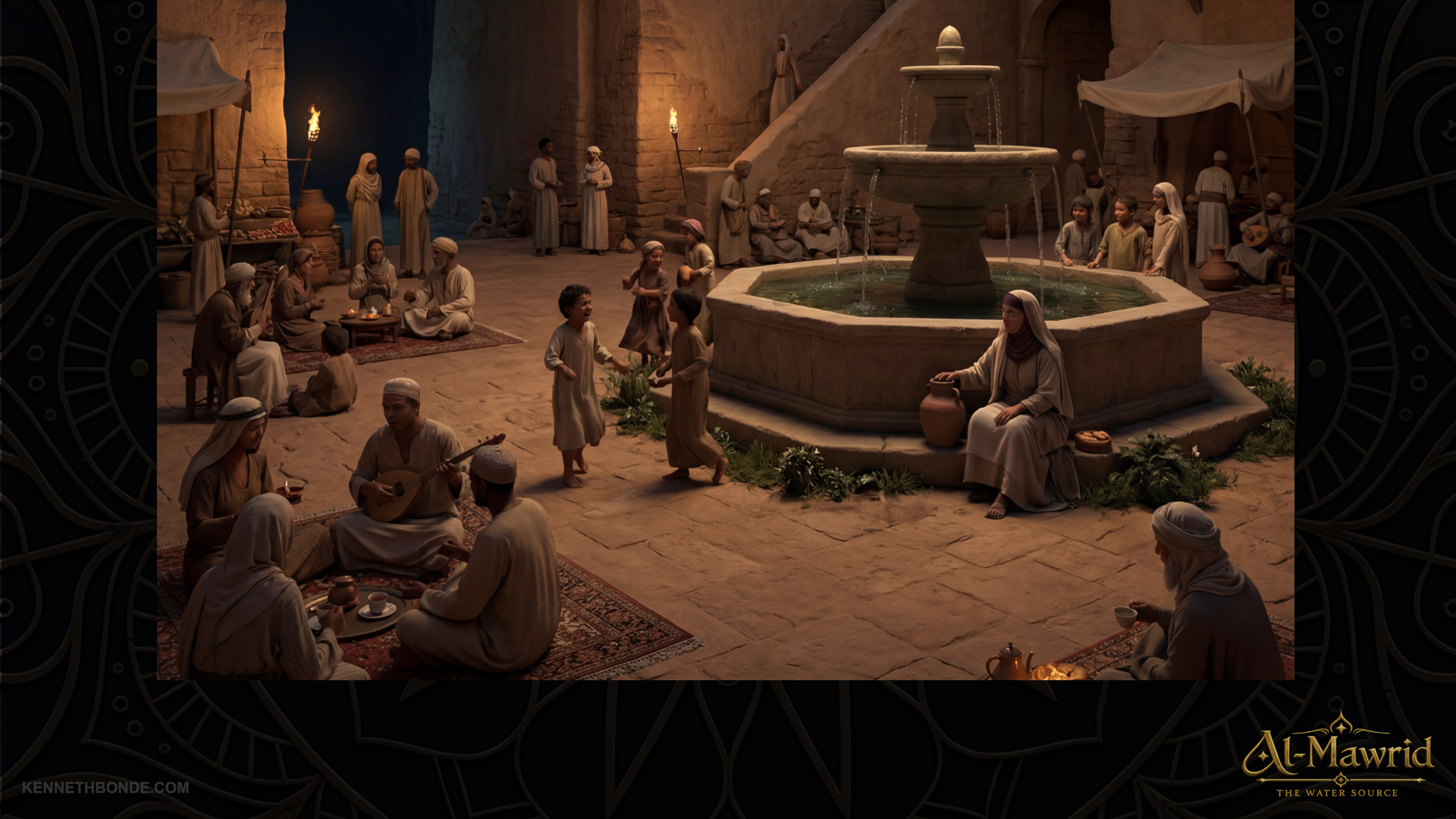
Underground cistern chamber in Al-Mawrid with people gathered around water in warm lantern light.

Foundations

Al-Mawrid is not a fortress placed in the desert. It is a settlement that exists because the desert allowed exactly one thing to survive there.

The oldest part of the world is the rock itself. The massive eroded formation is not simply a dramatic backdrop; it is the reason the settlement became possible. It provides shade, protection, elevated lookout points, and a natural container for hidden water systems.

The fortress should feel as if it was discovered rather than designed in a single moment. The lower structures appear older, heavier, and more directly connected to the volcanic geology. Later generations expanded upward with sandstone, creating a visible timeline of occupation.

Design intent

The viewer should sense that Al-Mawrid has grown slowly over centuries. Nothing should feel like a fantasy castle dropped into a landscape. The architecture must feel negotiated with the terrain, shaped by scarcity, repaired by generations, and defended because water made it valuable.

Water

Water is not a background resource in Al-Mawrid. It is the foundation of architecture, politics, ritual, trade, and fear.

The fortress exists because water exists. Every path, chamber, social hierarchy, and defensive decision is shaped by the need to collect, protect, distribute, and understand it. The cisterns beneath the settlement are not only engineering spaces; they are sacred spaces because they hold the line between life and collapse.

The people of Al-Mawrid would never treat water casually. A leaking wall is not a maintenance problem. It is a crisis. A poisoned cistern is not a crime scene. It is an attack on the future.

Visual language

Water spaces should feel cooler, darker, quieter, and more ritualized than the sunlit exterior. Warm lanterns, stone reflections, robed figures, narrow passages, and controlled access all help communicate that the most important part of the fortress may be hidden underground.
Architecture

The fortress appears less like a building and more like an extension of the landscape itself.

The lower architecture grows from the rock, suggesting early survival, defense, and adaptation. The upper city uses sandstone, suggesting later expansion, increased population, trade, and a society stable enough to build beyond immediate necessity.

This contrast is important. It tells history without needing exposition. The viewer can read the fortress as a record of time: the rock as origin, the sandstone as growth, scaffolding as maintenance, interiors as culture, and the cistern as the hidden heart.

Things to avoid

Al-Mawrid should not become generic fantasy architecture. Avoid decoration without purpose, random ornamentation, impossible structural choices, or buildings that feel designed only to look impressive. Beauty should come from adaptation, material logic, light, and accumulated history.

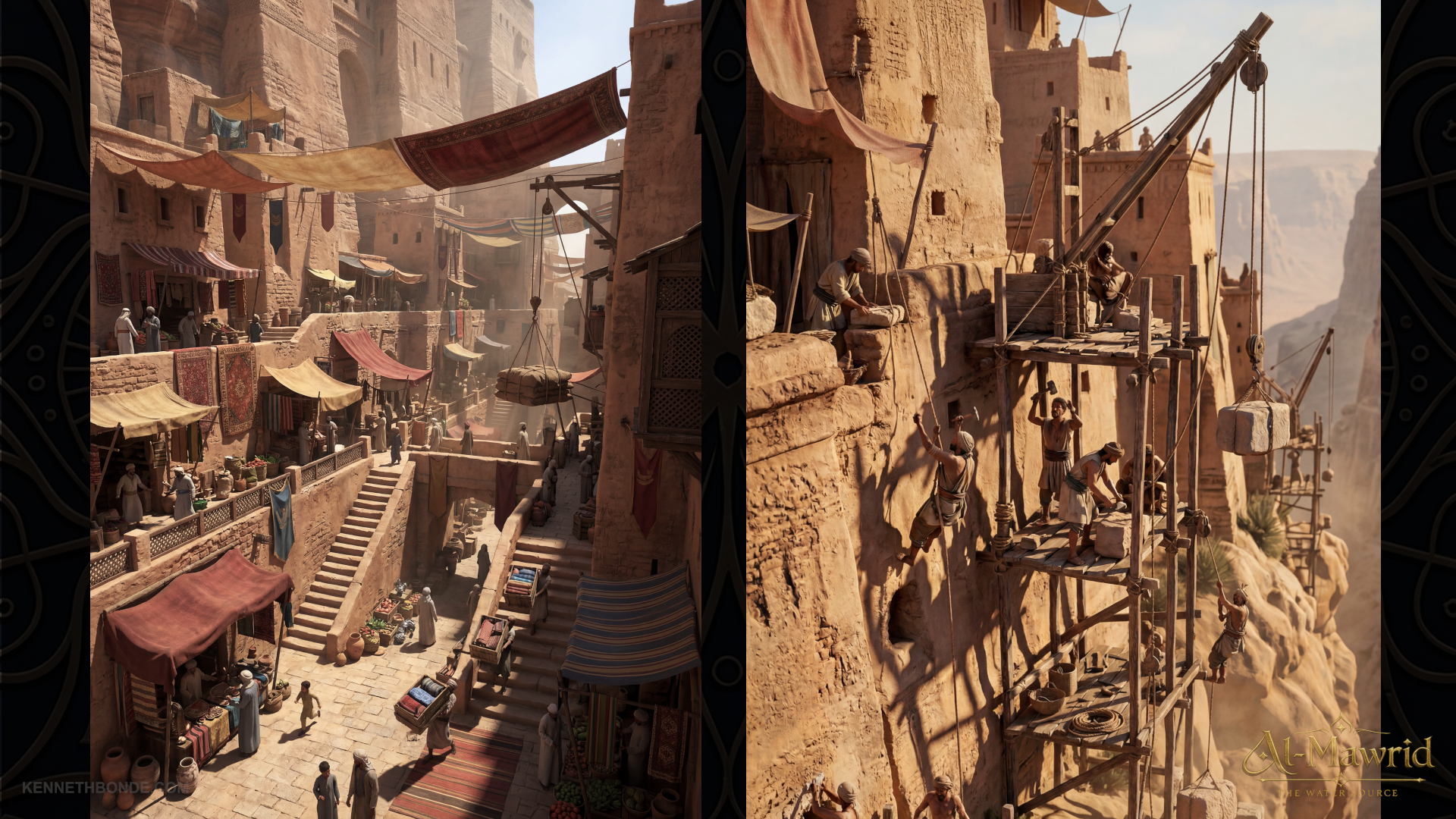
Workers and scaffolding inside Al-Mawrid, showing vertical architecture and daily maintenance.

Daily Life

The world becomes believable when the viewer can imagine what happens between the hero images.

Morning in Al-Mawrid would not begin with spectacle. It would begin with carrying water, checking seals, sweeping dust from thresholds, repairing shade cloth, preparing animals, opening small workshops, and listening for news from incoming caravans.

Children would know which passages stay cool in the afternoon. Guards would understand how dust changes before distant riders appear. Workers would recognize the sound of old scaffolding under stress. Priests or water keepers would know which cistern doors are opened only during ceremony.

These unseen routines matter because they make the paintings feel like windows into a functioning civilization rather than isolated cinematic shots.

Design Philosophy

Al-Mawrid was built from the inside out.

The project began with systems rather than decoration. Survival shaped architecture. Engineering shaped culture. Culture shaped ritual. Ritual shaped atmosphere. The images became stronger because they were supported by a world that had reasons to exist.

The guiding principle is plausibility over literal realism. The goal is not to prove every engineering detail, but to create enough internal logic that the audience instinctively accepts the world as functional.

Creative rules

Every object should have a purpose. Every building should suggest use. Every scene should answer one question and create two more. The world should feel larger than the image, and mystery should remain an active part of the experience.

Behind the Paintings

The images are the visible result. The real work was deciding what to keep, what to remove, and what the world should never become.

Al-Mawrid developed through reference, composition, iteration, editing, and worldbuilding logic. AI-assisted exploration was used as part of the visual process, but the authorship remained in direction: choosing the questions, shaping the world, rejecting weaker ideas, refining composition, maintaining continuity, and deciding what each image needed to communicate.

The most important decisions were often acts of restraint. Not every idea deserved to be shown. Not every mystery needed an answer. Not every scene needed more detail. The project became stronger when the world was allowed to breathe.

Things you may not have noticed

The project is built to reward a second look. These details are not trivia; they are part of how the world communicates its own history.

Why is the water underground?

Because the most valuable resource must be protected from heat, evaporation, theft, contamination, and political instability. Placing water below the fortress turns engineering into ritual.

Why does the fortress grow from rock?

The settlement should feel like people adapted to a rare geological opportunity rather than imposing a perfect design on the desert.

Why is decoration restrained?

Scarcity changes beauty. In Al-Mawrid, visual richness comes from material, shadow, textiles, ritual light, and human use rather than excessive ornament.

Why show ordinary moments?

Because daily life makes the world believable. A worker, a falcon, a lantern, or a quiet interior can carry as much worldbuilding as a battle scene.

The fortress was never the destination.
It was simply the first door.

Latest Discovery 4 July 2026 · Behind the Walls of Al-Mawrid is now open Read more →